Man convicted in 2014 denied new trial
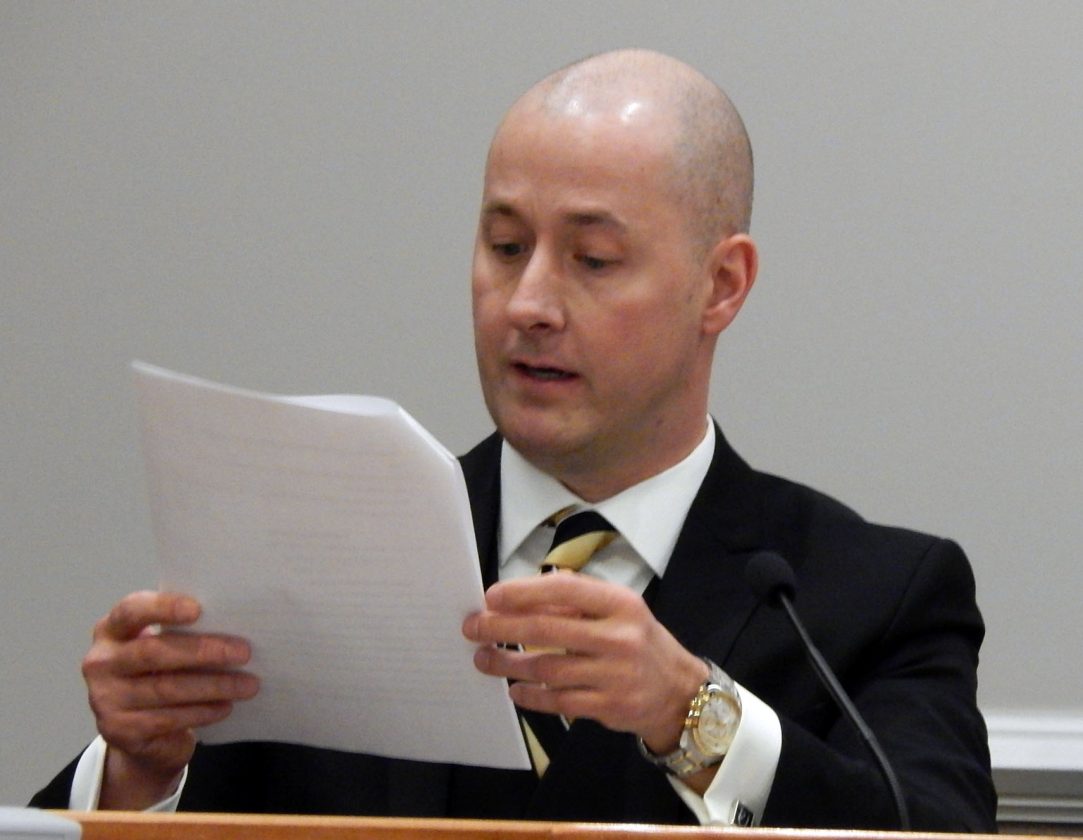
Telegraph file photo by DEAN SHALHOUP Attorney Mark Osborne, who represented Christopher Slayback in his 2014 sexual assault case, testifies at a hearing in Slayback's motion for a new trial, which a judge denied, vindicating Osborne.
NASHUA – Attorney Mark Osborne employed “a reasonable trial strategy,” and was otherwise effective in defending felonious sexual assault suspect Christopher Slayback in 2014, according to the Superior Court judge who denied Slayback’s request for a new trial.
Slayback, convicted by a jury of 9 counts of aggravated felonious sexual assault in October 2014, cited ineffective assistance of counsel in his motion for the new trial. He was sentenced in April 2015 to a minimum of 20 years in State Prison, 10 years less than the 30-year minimum recommended by prosecutors.
Slayback, 46, formerly of Merrimack, was indicted on two counts of AFSA in October 2013, then on seven additional counts in December 2013.
The charges accused him of developing a sexual relationship with a 14-year-old girl who had come to live with Slayback and his family a year earlier.
In her 26-page order denying Slayback’s new-trial motion, Judge Jacalyn Colburn stated she “carefully considered all the defendant’s basis for his claim of ineffective assistance of counsel” before handing down her ruling.
Colburn stated she concluded that “all the conduct (Slayback) complained of” regarding Osborne’s representation “lacks factual basis,” or was “based on a reasonable trial strategy
employed by Attorney Osborne,” or “did not affect the outcome of the case,” according to the order.
Among the main points Slayback raised in his motion was his assertion that Osborne “failed to pursue a plea offer” on his behalf, and failed to discuss a plea offer with Slayback during the course of the trial.
But Osborne refuted the accusation, citing a discussion with Slayback that centered on that very topic – and which Colburn noted in her ruling.
When Osborne took to Slayback a plea offer of 10-20 years in prison, with the possibility of some of the sentence suspended, Slayback wasn’t interested, Colburn indicates in the order.
Instead, he “made it clear to Attorney Osborne he was not willing to plead guilty to any crime … because he is innocent,” the order states. Slayback also cited the impact “to his family and his job” if he were to plead guilty as part of an agreement.
First Assistant Attorney General Leslie Gill, who opposed Osborne during the trial but argued in his favor in her objection to Slayback being awarded a new trial, said the record of the trial “clearly demonstrates” Osborne employed “a deliberately contemplated trial strategy.”
Slayback, Gill noted in her objection, “has made no showing of actual prejudice as a result of Attorney Osborne’s actions before, during or post-trial.
“At no time did (Osborne’s) conduct fall below the range of reasonably professional assistance,” Gill wrote.