MTI offers alternative to 4-year schools
Post secondary trade school opened in 2016 to meet industry demands
-

- Staff photo by Hannah LaClaire Joe Boston, executive director
-

- Staff photo by Hannah LaClaire Part of the model home at Maverick Technical Institute in which students can practice drilling, installing various pieces of equipment, wiring and other necessary skils.

Staff photo by Hannah LaClaire Joe Boston, executive director
NASHUA – Last year, Stephen Crocker was just a “21-year-old kid looking for a career,” but knew that a traditional four-year school was simply not part of his trajectory.
He wanted something hands-on, but that still presented an intellectual challenge.
Then, he found Maverick Technical Institute in Nashua.
MTI is a post-secondary trade school that opened in 2016 that was “created to meet the increasing demand for properly trained electronic systems technicians,” according to a school memo.
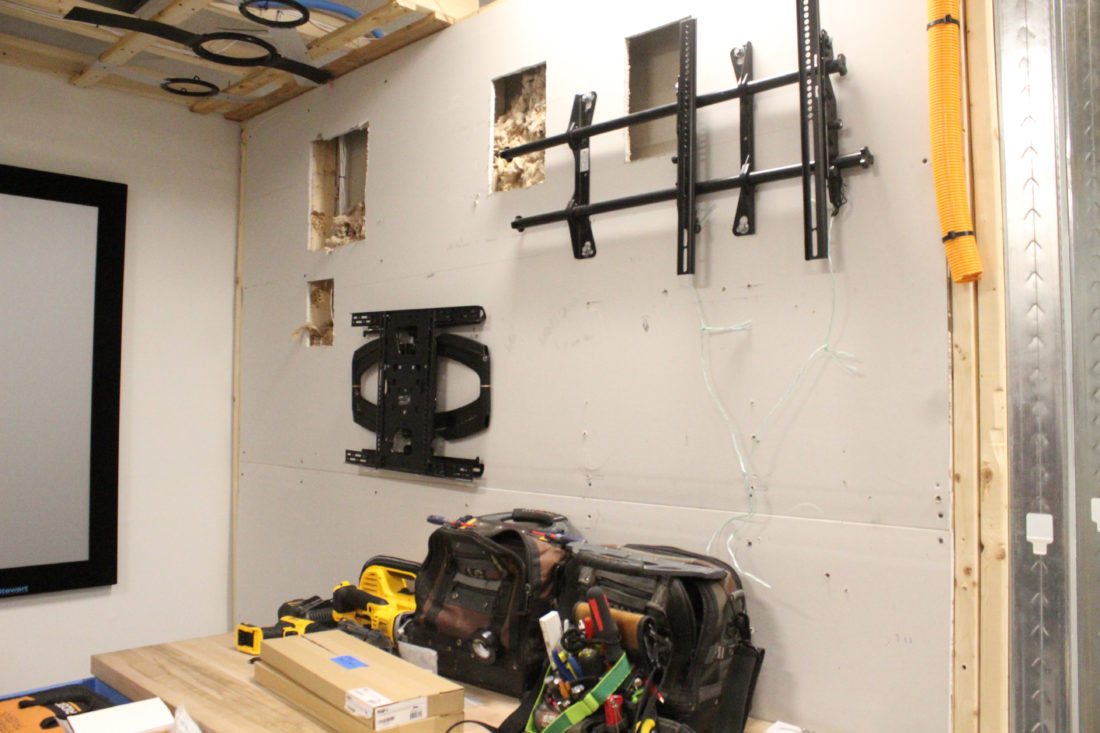
Staff photo by Hannah LaClaire Part of the model home at Maverick Technical Institute in which students can practice drilling, installing various pieces of equipment, wiring and other necessary skils.
MTI’s target occupations include residential electronics installation technician, home theater installer, live sound reinforcement technician, audio-visual technician, low-voltage field service technician and more. Those jobs are typically found within low-voltage integration companies such as Maverick Integration, right downstairs from MTI, and where Crocker is now employed.
For a school that was started with the sole purpose of meeting a need, they already are seeing success. In the first class of students, 80 percent of them were hired before graduation, said Joe Boston, executive director.
The average age for a technician is around 40, he explained, and in order for an industry to grow, younger employees need to be coming in as well.
In the eight-month, 1,100-hour program, students spend half their time learning theory, and the other half implementing the theory into practical, hands-on lab work. There are traditional-style classrooms, and the lab includes a section modeled after a home so students can practice wiring speakers into the ceilings, mounting televisions or even just drilling into the walls.
The course is broken down into 20 modules, starting with professionalism and including safety, codes and standards; prewire and cabling; fundamentals of sound and audio; motorization in the home and control systems and user interfaces.
They experience the practical application of their studies before they even leave: The first class installed a speaker system in the building, and the second added motorized window treatments to the classrooms.
The school offers a high level of base knowledge and, once hired, the new low-voltage technicians need only to learn the “idiosyncrasies of the company” they are working for, Boston said.
At the end of the course, students can take the Custom Electronic Design and Installation Association exam or the Electronic Systems Professional Alliance exam. By the time they have completed the program, they are certified to “augment homes or businesses with electrical equipment,” Boston said.
“There are a lack of schools that offer this,” he said, adding that students graduate with a living wage, making an average of $40,000 per year right off the bat.
Plus, the need for skilled laborers is so great, that Boston said he can “guarantee an interview in any state in the country.”
While the industry is seeking workers in this field, and actively recruiting MTI students, the general public, he said, remains skeptical.
He and his colleagues have been going around to high schools and colleges in the area to try to education people about what they offer.
“It’s a good opportunity to learn a skill set,” Boston said. “(You) don’t have to have experience, we wanted to make it palatable for everyone who comes in.”
Crocker suggested people keep an open mind when considering post-high school options.
“Explore your options. The college route is not for everyone, and there are plenty of trades that are always looking for steady people to hold down a job,” he said.
The program runs September through April. Tuition is $18,490, and includes a complete set of tools so students can hit the ground running, Boston said.
Maverick Technical Institute is located at 589 West Hollis St. and can be reached at 603-493-4834 or www.mti.school.
Hannah LaClaire can be reached at 594-1243 or hlaclaire@nashuatelegraph.com