First apartment units in century-old Cotton Mill will be available next month
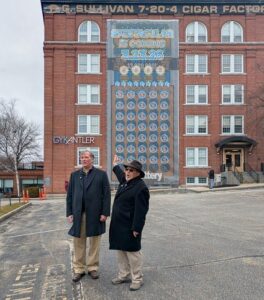
The Cotton Mill project in Nashua is nearing completion after years of work turning a decrepit, century-old warehouse into 109 apartments that celebrate the area’s workaday past, with occupants slated to start moving into the three upper floors as early as May.
The $22 million project sits on the north side of the Nashua River, just west of Main Street in downtown Nashua. It’s a stone’s throw across the river from Clocktower Place, which set Nashua’s template for downtown apartments inside old mill buildings when it opened 25 years ago, but there are big differences between the two projects.
Notably, Cotton Mill has fewer bedrooms, including some studio units and just a few two-bedroom apartments, than does Clocktower Place, which has three-bedroom units.
The differences reflect changes in people’s expectations as “new urbanism” has made it more attractive to live within walking distance of downtowns, said James Regis, senior vice president of S-C Management Corp., which runs both complexes.
“These are the first new studio apartments I’ve known about in Nashua,” Regis said. “People want living space more than bedrooms now.”
Cotton Mill also lacks some in-building amenities that were seen as necessary to lure people downtown when Clocktower Place was built, Regis said.
There’s no indoor swimming pool, no indoor convenience store, no full-time concierge, but developer John Stabile is betting this won’t be a hindrance when convincing people to pay $1,195 a month, plus utilities, for a studio apartment and up to $1,695 for a two-bedroom.
The idea is that the appeal of living in downtown Nashua, overlooking the cleaned-up Nashua River with its under-construction Riverwalk and canoe launch, just a few blocks from Main Street shops and restaurants, makes up for it.
“People don’t want to stay in the building. Walking is part of the attraction,” Regis said.
Cotton Mill does have a gym and health club, which are apparently required in modern life.
Another change for modern sensibilities: Whereas Clocktower Place only allows cats, Cotton Mill also will allow dogs.
About half the Cotton Mill apartments are reserved for affordable housing, with compliance overseen by the New Hampshire Housing Authority, and half will be market-rate units.
Cotton Mill is not yet taking deposits on units but has unspoken agreements with some would-be renters who have toured the site and picked out units they like. Pre-leasing tours are available most weekdays. Information can be found at www.cottonmillnh.com or by calling 881-4222.
The building has 20 different floor plans, but even similar units are not identical because of the vagaries of mill construction – particularly on the 8th floor, where the sloping roof leads to lots of slanting brickwork and lowered windows.
As is now common in converted mills, signs of its past have been left exposed, from old brick walls visible throughout the interior (although not on the outer-most walls, which were covered inside for insulation purposes), to exposed beams and pipes and woodwork.
Clocktower Place is more finished-looking, with drywall hiding virtually all of its industrial history.
“Back then, if you left pipes, wires uncovered it would seem unfinished, unkempt,” Regis said. “These days, mill buildings are more interesting, dynamic places to live.”
The two projects have a related past, but their designs as dwellings are also different because of that history. Cotton Mill was a warehouse that stored cotton bales that were sent across the river on what is now a walking bridge, so they could be turned into clothing and blankets in the textile mills that are now Clocktower Place.
As a result, Cotton Mill has lower ceilings than Clocktower Place, since it didn’t need room for overhead belts and mechanisms, and it lacks the huge windows that were required in working areas before electric lighting. Windows had to be cut into its east and west walls, which were entirely blank in its warehouse days.
Clocktower Place, which involves three buildings, was a much larger project, with 326 units.
The Stabile Co. has been working with the Cotton Mill project for more than seven years. Its vision was to demolish the eight-story, 160,000-square-foot warehouse, which was built in 1905, and some surrounding buildings, to construct 162 condominiums. The Nashua City Planning Board first gave the project its blessing in 2006, but the recession squashed those hopes by upending the condo market.
Financing has included some $10 million in historic and low-income housing tax credits, more than $1 million in Stabile Co. equity, $2.2 million in city and state funds, more than $600,000 in EPA loan funds, and $1 million in Community Development Finance Authority state tax credits. It only became certain in early 2013, however, when the U.S. Department of Housing and Urban Development approved a roughly $11 million permanent loan for the project.
Also in 2013, aldermen approved a five-year tax freeze on the project after the city adopted a state law that encourages investment in downtowns and village centers.
Cleaning up the long-abandoned site was not easy, as it was contaminated with asbestos, lead paint, fuel oil, carcinogenic polycholorinated biphenyls, or PCBs, from its Nashua Manufacturing Co. and Nashua Corp. past. It also involved rebuilding the Jackson Falls dam, so that the site is no longer in the 100-year floodplain.
As of Tuesday, construction was proceeding throughout the site, from a retaining wall along the river to unfinished parking lots and installation of drywall on lower floors.
But Regis said the company was confident all would be finished in time for the tenants to move into the 6th, 7th and 8th floors in May, with full occupancy slated for this fall.
David Brooks can be reached at 594-6531 or dbrooks@nashua
telegraph.com. Also, follow Brooks on Twitter (@GraniteGeek).