Nashua’s Great Harvest Bakery teams up with ASD to explore the “Science of Baking”
When Jeremy St. Hilaire was a young student, he didn’t learn by reading, writing or listening to a lecture in class, he learned by doing.
“That’s how the knowledge really sunk in,” he said.
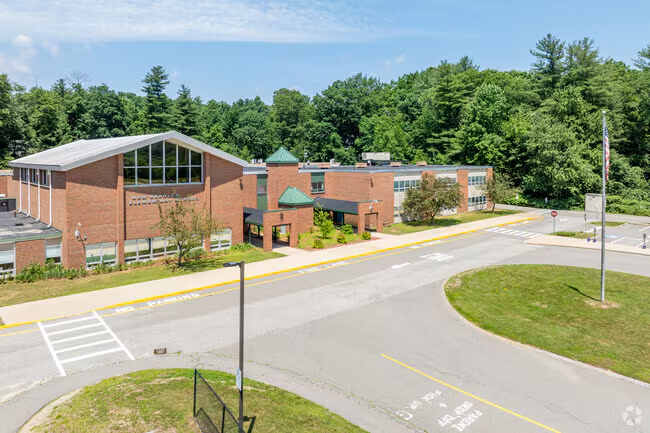
Now, St. Hilaire, owner of Great Harvest Bakery, is hoping to provide the same hands-on learning opportunities to a group of students from the Academy for Science and Design public charter school.
St. Hilaire teamed up with ASD teacher Andy Murray to lead a “Science of Baking” course, which meets Monday afternoons as part of the charter school’s afternoon enrichment period.
On Monday, the group of about 12 students were gathered around a table in the bakery’s back room, learning about leavening agents, like yeast, and how they can be used to make breads and other baked goods rise faster or slower.
“You smell that?” St. Hilaire asked the students, passing around a tub of water, flour and yeast, which was rising before the students’ eyes. “That is alcohol, that’s the yeast fermenting.”
The science program began about five weeks ago, after St. Hilaire’s bakery helped cater an event held by the charter school.
Murray said Great Harvest Bakery had already shown it was willing to support ASD, and he thought teaming up with St. Hilaire to educate students would be a good next step.
“This is all science stuff,” Murray said Monday, watching as St. Hilaire worked with students. “It’s letting students see how what they’re learning applies to everyday life.”
Still, the idea was initially intimidating to St. Hilaire.
“Teaching a science school about science?” he said. “It made me a little nervous. I’ve been baking for years, and we do these very science things, but you don’t think about it in that context.”
Murray said this is often a problem for students as well. Even at ASD, where students attend because they have a strong interest in math and science, young people struggle to see how the things they are reading and learning about in class apply to real world jobs.
Letting the students see that there is science behind even seemingly everyday activities like baking can help combat that issue, he said.
On Monday, students worked with St. Hilaire to determine why a baker would use yeast, or some other leavening agent, when baking.
St. Hilaire explained, while passing around the tub of water, flour and yeast, that yeast is a living organism. Give it warm water, something to feed on – flour in this case – and the right space, and it will grow.
Make the water too warm, however, and the organism dies, keeping bread and other baked goods from rising properly.
Still, St. Hilaire said that while yeast is important to the process of baking bread, it’s not so good for making muffins, scones and similar baked goods. Instead, bakers want a leavening agent that will help the baked goods rise quickly, and that won’t be stopped by high temperatures.
Baking soda or baking powder, he said, works well. To demonstrate how those products work, he helped the students make a simple candy, with baking powder, sugar, honey and butter.
After cooking at a high heat for only about five minutes, the candy had turned to a caramel liquid. Poured out onto some wax paper, it quickly rose and hardened, forming a wafer-like substance with bubbles throughout, visible when St. Hilaire smashed a sheet of the candy on the table.
“Wow, look at all that carbon dioxide!” one student exclaimed, looking at the bubbles while happily munching on the candy.
For eighth-graders Becky Moser, Kimberly Ortega and Alex Kelley, the Science of Baking class has changed the way they view baking.
Ortega said she hadn’t done much baking before joining the class, “unless you count something out of a box,” and that she was surprised to learn just how much science goes into the process.
“I was looking for something fun to do,” she said Monday. “I’ve learned a lot.”
Kelley said he’ll never look at a slice of cake the same way again.
“A lot of people think you just put something in the oven, but it’s so much more than that,” he said. “It really is a science.”
St. Hilaire said he’s happy to see his lessons are paying off.
He’s always been a hands-on learner himself, and works that way with his own employees, requiring them to practice cleaning procedures, using the ovens and other bakery tasks multiple times during training.
For many students, he said, learning through hands-on experience is the best way to truly understand something and get excited about learning.
“These kids are just so bright,” he said. “I show them the tub of yeast and water, and they ask me, ‘When did you start this?’ Most kids wouldn’t know to ask something like that. It’s fun to talk about what we do on a daily basis and to see these kids’ eyes opening up to it. It’s all just baking until we explain it to them.”
Danielle Curtis can be reached at 594-6557 or dcurtis@nashua
telegraph.com. Also, follow Curtis on Twitter (@Telegraph_DC).