Delivering milk was Ideal business
Until someone finally set me straight many moons ago, I’d argued more than a few times that milk, at least in our neighborhood, had nothing to do with cows.
Nope, I insisted, our milk came from a tall guy named Mr. Boyer and his little, snubby-nosed truck that had no seats.
I knew, because two or three times each week, I saw him walk up our driveway, open a silver box, put in three or four bottles of milk and take the empty ones away.
I think it was around the time I found out that indeed, cows do figure in the milk-making equation that I also realized Mr. Boyer wasn’t the only guy who brought people milk.
At school, for instance, I quickly noticed we drank some other kind of milk than Mr. Boyer’s – instead of the curvy red “Producers,” these bottles had the words “Ideal Dairy” on them.
Now, a half-century, a bunch of mergers and takeovers, and a ton of Cumberland Farms later, it’s easy to laugh at my gradual discovery that Mr. Boyer and his scores of fellow Nashua milkmen were our ever crucial “middlemen” between cow, farmer and the breakfast table.
A look back at the “golden age” of neighborhood route milkmen, “breadmen,” “butter-and-eggmen” and so forth would be woefully lacking without tapping the memory banks of Ernie Lozeau, one of two surviving “Lozeau Boys” whose family founded the original Ideal Dairy in 1927 at the corner of Allds and McKean streets.
Visitors to the Nashua Historical Society this month can relive some of those deliveryman days through an exhibit of paraphernalia Lozeau collected over the years.
Born on Nashua’s Crown Hill the fifth of six boys to Canadian natives Euchariste and Elphema Lozeau in the middle of the Roaring ’20s, Ernie Lozeau – who also had three sisters – grew up in and around the fledgling dairy, a venture his father started after a short-lived delivery route for Sugarloaf bread fizzled.
He had yet to start grade school when, on a warm Sunday in early May, the family’s home and livelihood disappeared in a matter of hours, devoured along with scores of other homes and buildings in Nashua’s famous 1930 Crown Hill Fire.
Euchariste Lozeau reopened the dairy on Ritter Street, the location for which it’s best known. Around age 10 or 11, Ernie Lozeau was given a collection route, pedaling his bicycle to customers’ homes for that week’s payment.
“Like a paperboy,” Lozeau said with a grin.
In no time, he graduated to a motorized delivery route, piloting the little standup trucks around the city and area. Like anything else, some routes were more popular than others, and for the Lozeau Boys, the primo job was the route that included St. Joseph Hospital – and its School of Nursing.
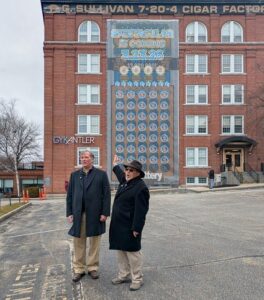
“The brothers used to fight over who’d get that route,” Marjorie Lozeau, who accompanied her husband to the Historical Society the other day, said with a laugh.
She ought to know: She was one of the nursing students who watched, probably giggling, as “the boys” tripped over each other to impress the young ladies.
Not only did Ernie’s perseverance pay off, two of his brothers also met their future wives at their favorite stop on their favorite route.
Ernie Lozeau, who graduated from Nashua High School in 1943, remembers how his dad cleverly compensated for the wartime shortage of gasoline, one of many things that fell to rationing.
“We’d started out with (delivery) trucks, but when you couldn’t get (enough) gas, my father got a couple horses and buggies to do the closer routes,” he said. “We packed (the wagons) with ice and straw, kept the milk nice and cold.”
Of all Ideal’s successes over the years, two stand out in Ernie Lozeau’s memory: Golden Guernseys and amber bottles.
“They were special cows,” he said of the Guernseys, brown-and-white Vermont cows known for their quality milk.
“It was the best you could get,” Lozeau said, his eyes brightening.
The boys drove to Vermont daily for the premium milk, which Lozeau said was so rich and creamy, “You could clarify it down to 2 percent (milk fat) and it was still better than regular milk at 3.6 or 3.7.”
With that and their increasing use of the amber-tinted milk bottles on its side, Ideal continued growing, Lozeau recalled.
“We had the schools,” he said, meaning the dairy supplied local public schools’ milk – those little bottles, and later, cartons, we got with snacks and at lunch.
The purpose of the amber, or brown, bottle was to filter ambient light, allowing the product to retain its freshness longer. By the 1950s, ads regularly appeared in The Telegraph touting the off-color bottles.
“New Amber Bottle Protects Milk” a 1953 ad announced. “Sunshine is good for growing plants, but not for milk.”
“The easiest pouring bottle in use … protects milk from harmful light!” shouted another ad, which ran in 1954 at just about the time Nashua’s phones went to dial and Ideal’s number switched from 2322 to TU3-8991.
Dave Lozeau remembers accompanying his father on routes as a kid, such as the time a huge snowstorm tried to stop the milk from going through. Undaunted, the elder Lozeau slid several bottles into his wire carrier and set off on foot.
“I think it was up on Long Hill, I remember him saying there’s a family way down the street with kids, they need their milk,” the younger Lozeau said. “It’s how we did things back then, helped others out.”
Growing up surrounded by the milk business, Dave Lozeau made his own – albeit brief – foray into the related ice cream business when he and his father discovered an abandoned ice cream truck in the woods in Merrimack.
“We brought it home and refurbished it,” said Dave Lozeau, who was in high school at the time.
The brand name happened to be Mr. Softee, one of several variations the new soft-serve product was called.
“It didn’t last, though,” he added.
“Why, wasn’t it profitable?” a visitor asked.
“Wasn’t that. … Everyone in school started calling me ‘Mr. Softee,’?” Lozeau said as his father and mother laughed.
“That was the end of that.”
Dean Shalhoup’s column appears Saturdays in The Telegraph. He can be reached at 673-3100, ext. 31, or dshalhoup@nashuatelegraph.com.