Supreme Court justices weighing state’s EES appeal following Wednesday’s oral arguments
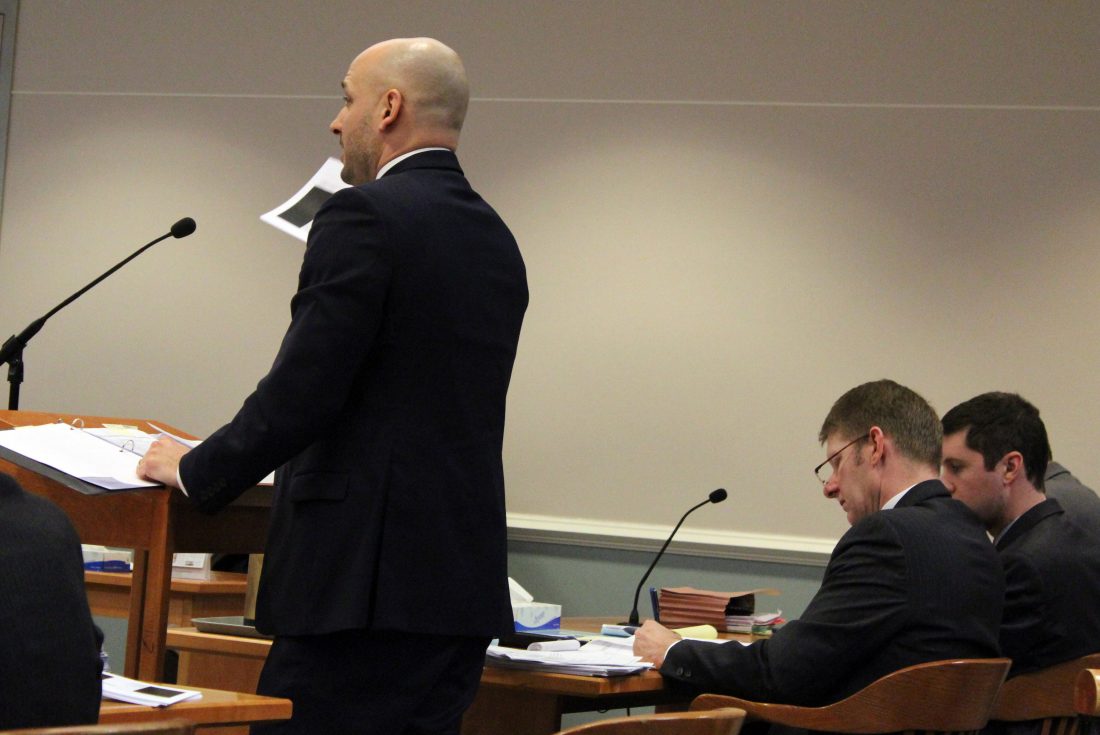
Telegraph file photo by DEAN SHALHOUP Gilles Bissonnette, legal director for the American Civil Liberties Union of New Hampshire, holds up a redacted EES list at a February hearing while arguing in favor of the petitioners in the right-to-know suit against the Department of Justice. At right is Solicitor General Daniel Will.
CONCORD – The justice department’s Exculpatory Evidence Schedule is “an imperfect list” that “is likely to be both under inclusive and over inclusive,” because it was never designed to be a public document or public record, state Solicitor General Daniel Will told five Supreme Court justices Wednesday.
But keeping the EES secret is “bad for public confidence in law enforcement,” and denies New Hampshire’s taxpayers their right to know whether police officers who charge them with crimes have themselves been accused of wrongdoing by their supervisors, American Civil Liberties Union of New Hampshire director Gilles Bissonnette countered during the roughly 35 minute hearing.
Five justices, two of whom appeared via video conference, heard oral arguments Wednesday in the Right-to-Know case in which several state news outlets and the ACLU-NH took the state to court more than two years ago over whether the contents of the EES – formerly known as the Laurie List – should be public information under RSA 91a, the state’s Right-to-Know law.
The arguments, delayed somewhat by the scheduling issues brought on by the COVID-19 pandemic, come more than a year after Will, on behalf of Attorney General Gordon MacDonald, appealed to the Supreme Court an April 2019 Superior Court ruling that the EES is not confidential.
Despite the ruling, made by Superior Court South Judge Charles Temple, Will declined to release an un-redacted copy of the EES, asserting at the time that the order wasn’t final.
On Wednesday, one of the plaintiffs, the New Hampshire Union Leader, was represented by Attorney Gregory Sullivan, while Bissonnette argued on behalf of the other plaintiffs.
Those include, in addition to the ACLU-NH, the New Hampshire Center for Public Interest Journalism, The Telegraph of Nashua, Newspapers of New England Inc., through its New Hampshire properties, Seacoast Newspapers Inc., and the Keene Publishing Corporation.
Bissonnette said that while Sullivan has been representing the Union Leader separately since the beginning, he and Sullivan have collaborated throughout the case.
Also present was Attorney Charles Douglas III, whom Sullivan recognized during his presentation.
Will represented the state and MacDonald’s office at the hearing.
On the bench Wednesday were Senior Associate Justice Gary Hicks, Justice Anna Barbara Hantz-Marconi and retired Superior Court Judge Kenneth Brown.
Participating via video conference were Justice Patrick Donovan and retired Superior Court Judge Gillian Abramson.
Justice James Bassett had previously disqualified himself from hearing the case.
The sides reiterated many of their previous arguments at Wedneday’s hearing, including the state’s position that the EES is part of police officers’ personnel files, and therefore confidential and exempt from the Right-to-Know law.
Rather, the EES is “a tool … used to discharge” the state’s responsibility to make sure all criminal defendants are notified if an officer testifying against him or her is on the EES list, an indication that the officer may have credibility issues that could negatively affect their ability to testify truthfully.
The plaintiffs have insisted all along that the EES list is not part of an officer’s confidential personnel file, and therefore should be available for public inspection under RSA 91a.
According to the Center for Public Interest Journalism, which operates the Website InDepthNH.org, there are currently 264 names on the EES. The redacted copies list only the department the officer works for, a date of notification and “category,” which lists the nature of the alleged infraction, such as “falsifying reports or records,” “truthfullness,” credibility,” or “issuance of unlawful orders.”
Redacted are the officers’ names and the date of incident, and there’s no indication whether they were punished or reprimanded or if they are still working in law enforcement, and where.
Will, the solicitor general, also argued Wednesday that “public interest in disclosure (of the redacted information) is very low,” partly because the documents have so little information on them.
But Bissonnette countered that “even if the records are incomplete … or complicated, the government should still provide” them to the public.
“RSA 91a assumes the public can be trusted with information,” he added, citing as examples criminal indictments, which are made public within a few days after the grand jury hands them up.
“Sometimes, they are made public before the defendant (begins) getting due process,” Bissonnette added.
As for the state’s claim that publicizing the names of the officers on the EES could stigmatize the ones who were later cleared of all accusations, Bissonnette said such a development “would also be public,” and that an officer’s “removal from the list would be public record as well.”
Sullivan, meanwhile, argued that the public interest in making the ESS public is that it would create “more transparency … it would make it a better public record. To me, it’s important for the public to know who the officers are on this list.
“You have the right to know whether this officer has been deemed by his or her chief to have issues,” he added.
Treating the EES as confidential, Sullivan said, causes all officers “to get tainted by a secret list. We have the right to know who they are.
“The answer is always more transparency (leads to) more credibility.”
The justices, in recessing the hearing, told the parties they are taking the matter under consideration. They didn’t give an estimated time frame for their ruling.
Dean Shalhoup may be reached at 594-1256 or dshalhoup@nashuatelegraph.com.