South junior wins Barron Prize with HALO-Vox
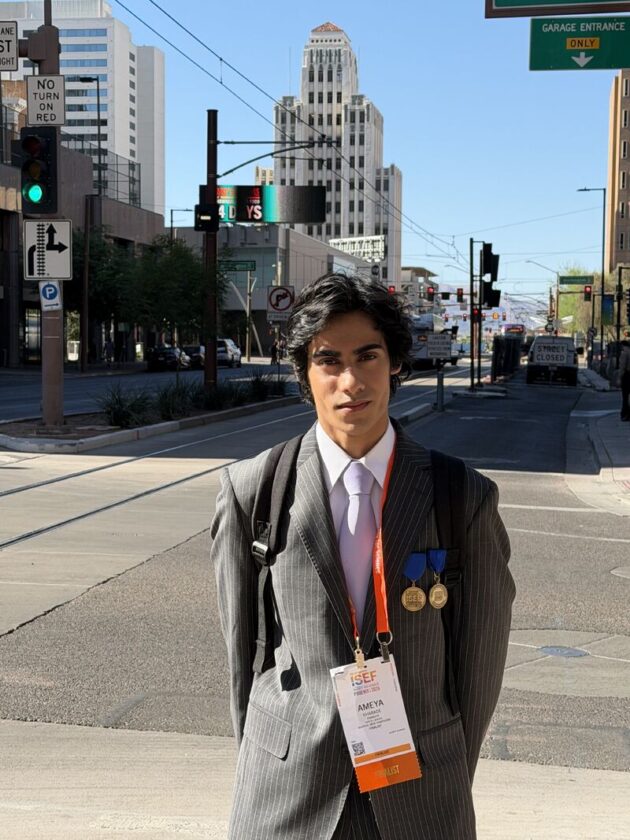
Ameya Kharade, a 17-year-old junior at Nashua High School South, was one of 25 high school students to be awarded the Gloria Barron Prize for Young Heroes. Courtesy photo
NASHUA – Ameya Kharade, a 17-year-old junior at Nashua High School South, was one of 25 high school students to be awarded the Gloria Barron Prize for Young Heroes.
Kharade was recognized for his HALO-Vox communication device, which uses brain activity to produce speech. The device is particularly beneficial for the five million individuals who have suffered a stroke or who are living with conditions such as amyotrophic lateral sclerosis and locked-in syndrome.
When Kharade was seven years old, a member of his family suffered a stroke and could no longer speak. Six years later, Kharade began conducting neuroscience research that ultimately led to the development of the HALO-Vox.
He spent a year working alone in his garage for six hours a day learning the mathematical components of information theory, creating algorithms, coding, conducting more than 100 human trials and writing a 60-page research paper.
“I’ve learned that persistence isn’t about confidence,” said Kharade. “It’s about being committed enough that giving up isn’t something you can live with.”
At a cost of $1,800, the HALO-Vox performs at a higher level than surgical speech implants, which, according to Duke University, can cost up to $100,000.
Traditional surgical implants produce three to 10 words per minute. However, the HALO-Vox produces more than 60 words per minute, fast enough to keep pace with a standard conversation.
“Nothing is more inspiring than stories about heroic people who have truly made a difference to the world,” said T. A. Barron, who established the Barron Prize in his mother’s memory. “We need our heroes today more than ever. Not celebrities, but heroes, people whose character can inspire us all. That is the purpose of the Barron Prize, to shine the spotlight on these amazing young people so that their stories will inspire others.”
During his sophomore year, Kharade developed a new way of detecting Alzheimer’s disease, Novel Brain Aging Analysis With CLIMB. He presented his project at the Regeneron International Science and Engineering Fair in May and was awarded first place as well as $6,000.