Gate City Voices pushes the vote
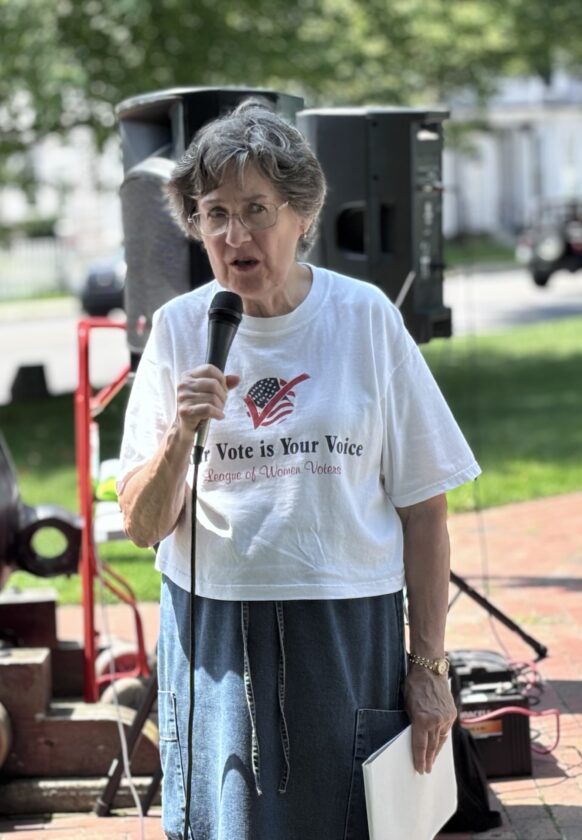
Elizabeth Tentarelli, president of the League of Women Voters New Hampshire, delivers her remarks during Unite & Rise: Voting Rights Day of Action on Aug. 8. Telegraph photo by CHRISTOPHER ROBERSON
NASHUA – With the primary mid-term elections less than a month away, members of Gate City Voices gathered at the Soldiers and Sailors Monument for a rally focused on the importance of voting.
“Be proud of yourselves, you’re ambassadors for voting,” said Elizabeth Tentarelli, president of the League of Women Voters New Hampshire, during the Aug. 8 event, Unite & Rise: Voting Rights Day of Action.
During her presentation, Tentarelli spoke about the history of the Voting Rights Act, which was signed into law on Aug. 6, 1965 by then-President Lyndon Johnson.
“For the first time, it put teeth into the 15th Amendment,” Tentarelli said of the landmark legislation.
The 15th Amendment, which was ratified in February 1870, states: “The right of citizens of the United States to vote shall not be denied or abridged by the United States or by any state on account of race, color, or previous condition of servitude.”
Although African-American men had the right to vote, states could still make it as difficult as possible without violating the 15th Amendment. Tentarelli said this was done by implementing poll taxes, impossible literacy tests and grandfather clauses.
This culminated in the 54-mile Selma to Montgomery march in Alabama on March 7, 1965. The peaceful march was interrupted when police attacked the group of 600 activists on the Edmund Pettus Bridge in what became known as “Bloody Sunday.”
After watching the brutality unfold on television, Johnson travelled to Alabama to meet with then-Gov. George Wallace to ensure that such an incident would never happen again. Eight days later, Johnson delivered his famous “We Shall Overcome” speech to Congress to accelerate the passage of the Voting Rights Act.
Tentarelli said that prior to being president, Johnson, as the Senate majority leader, viewed voting as a “basic right.”
“President Johnson recognized how important voting rights were,” she said.
Section 2 of the law states: “No voting qualification or prerequisite to voting, or standard, practice, or procedure shall be imposed or applied by any state or political subdivision to deny or abridge the right of any citizen of the United States to vote on account of race or color.”
However, Tentarelli said the Voting Rights Act has been weakened by two decisions from the U.S. Supreme Court.
In Louisiana v. Callais, which was decided by a 6-3 vote in April of this year, Justice Samuel Alito said Section 2 did not require Louisiana to create a second district for African-American voters. Therefore, there was no reason to use race as the basis to create the district and doing so was an “unconstitutional racial gerrymander.”
In Shelby County v. Holder, which was decided in June 2013, the court ruled 5-4, that Section 4(b) was unconstitutional. The decision eliminated the 48-year method which had been used to decide which states and municipalities needed federal approval to change their voting laws. The decision also meant that Section 5 was no longer enforceable and that voting laws could be changed without federal approval even in places that have a history of voter suppression.