DHART emergency medical chopper team to speak at Aviation Museum
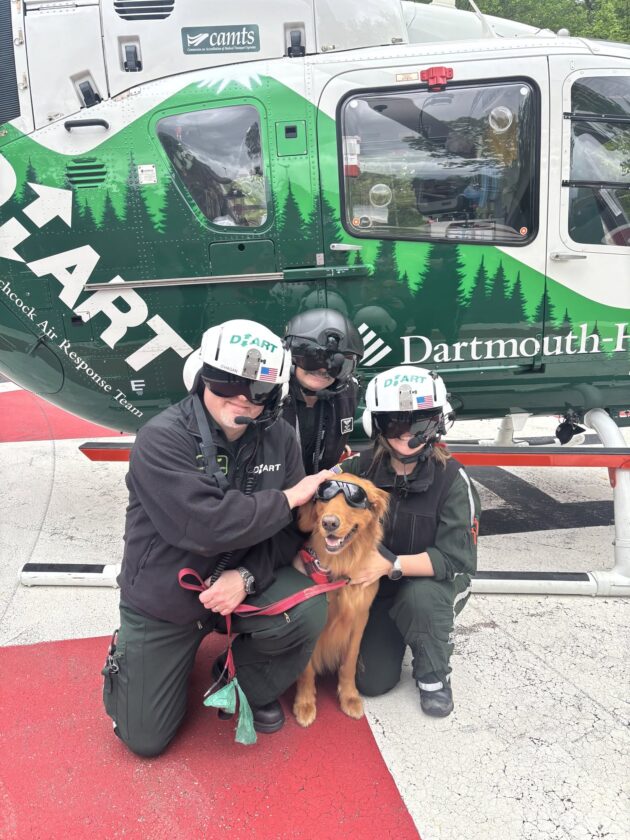
Monty the "flight pup" therapy dog, and Dartmouth Hitchcock Advanced Response Team crew members. Courtesy photo
LONDONDERRY — It’s not just superheroes who fly to emergencies.
Members of the Dartmouth Hitchcock Advanced Response Team are on call 24 hours/seven days a week to respond to emergencies via helicopter in cases where time is often as critical as the care services they deliver in flight.
For more than three decades, DHART has been delivering pre-hospital and critical care treatment, transporting patients to medical facilities across New England via helicopter or by specialized critical care ambulance.
Join the DHART crew for a presentation about what a career in air medical transport looks like at the Aviation Museum of New Hampshire on July 9 at 7 p.m. Admission is $10 per person and museum members are admitted for free.
From bases in Lebanon and Manchester-Boston Regional Airport in Manchester, the team of acute care and retrieval specialists from Dartmouth Hitchcock Medical Center operates a fleet of two Airbus H135 helicopters and two specialized critical care ambulances.
DHART began operations on July 1, 1994 and received its first request only seven minutes after going online. More than 30 years later, DHART has become an essential component of healthcare in northern New England.
The program completes more than 1,500 missions each year and has reshaped how critical care is delivered to the more than 2 million people living in New Hampshire and Vermont, as well as neighboring states.
Before DHART was formed, northern New England was one of the few regions in the country without air medical transport.
That meant that when someone was injured in a car accident on a hard-to-reach back road, for example, the person had to wait–sometimes hours–for paramedics to wind their way through the mountainous, rural terrain on the ground to reach them.
Once help did arrive, the nearest hospital might have just a handful of emergency room staff, with minimal equipment at their disposal, as many small community hospitals lack critical care resources.
This meant more travel for the patient, sometimes hours more, to Dartmouth Hitchcock Medical Center, which is New Hampshire’s only Level 1 trauma center.
The presentation, part of the museum’s Exploring Aviation lecture series.