
Donchess criticized for exceeding three percent budget limit

Resident William Ferriero questions Mayor James Donchess during the June 8 budget hearing. Courtesy photo/Nashua Community Television
NASHUA – Mayor James Donchess withstood a torrent of criticism from residents Frederick Teeboom and William Ferriero for breaching his own increase limit of three percent in the budget for fiscal year 2027.
This year’s $501.5 million spending plan represents a $26.6 million increase over last year. Within the total figure, the proposed operating budget of $384.2 million is 6.4 percent higher than last year.
“The 6.4 percent is kind of in line with what other communities are facing,” Donchess said during the June 8 public hearing.
As he has done in prior years, Donchess sent a memorandum to all department heads asking them to submit budgets that were no more than three percent higher than last year.
Donchess said the School Department budget, including benefits, is currently at $205.3 million, an increase of $14.1 million. He said the district’s student population is still hovering around 10,000 with a cost of $4,300 per student. While Nashua received $65 million from the state in education funding last year, Donchess said New Hampshire continues to have the lowest level of education funding in the nation.
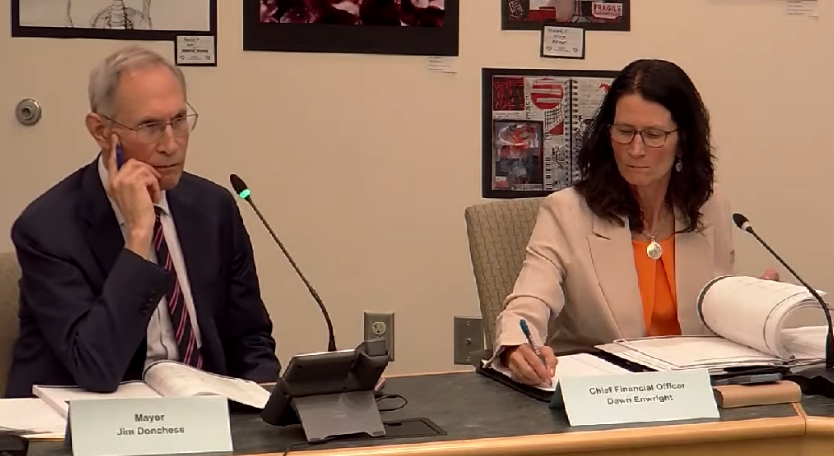
Mayor James Donchess and Chief Financial Officer Dawn Enwright during the June 8 budget hearing. Courtesy photo/Nashua Community Television
“The low level of state funding has been ruled unconstitutional by the New Hampshire Supreme Court multiple times over 30 years,” he said.
In addition, he said the School Department proposed cutting 56 positions for a savings of $2.4 million and that Nicholas Miseirvitch will now be overseeing information technology services for both the city and the schools for a savings of $100,000.
Donchess said the school budget also reflects an additional reduction of $668,000.
“This is beyond the 56 positions,” he said.
Some of the other larger line items include $180.8 million for salaries, $60.7 million for the Enterprise Fund, $35.6 million for Nashua Fire Rescue, $17 million for the Division of Public Works and $43.3 million for the Nashua Police Department.
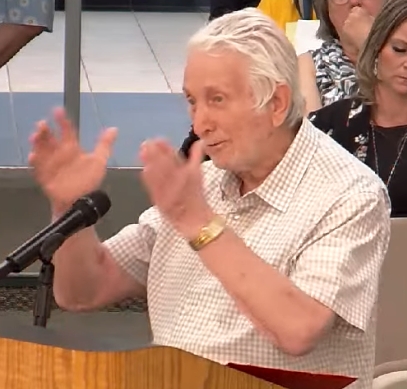
Resident Frederick Teeboom questions Mayor James Donchess during the June 8 budget hearing. Courtesy photo/Nashua Community Television
Donchess said the police budget includes $900,000 for new body cameras as the current cameras are five years old.
“The body cameras they have are now obsolete,” he said.
Regarding fixed costs, he said employee health benefits are up by $3.4 million, special education contract services are up by $1.8 million, school transportation is up by $1.7 million, out of district special education tuition is up by $1 million, the Hillsborough County tax is up by $1.7 million and nonmedical insurance policies are up by $1.5 million.
“Some of these fixed costs are going up very rapidly,” said Donchess.
He also proposed $4.7 million in reductions. The largest being a $2 million cut to the CERF appropriation for equipment purchases and reducing salaries by $1.7 million.
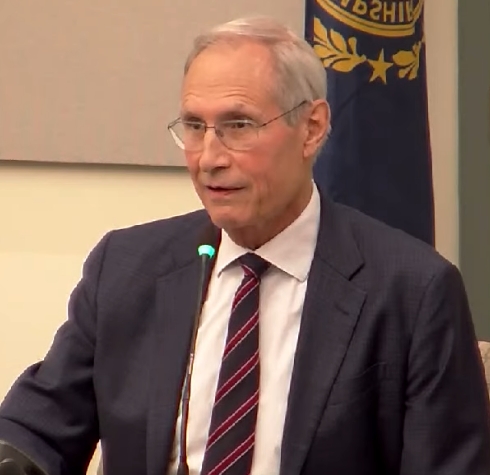
Mayor James Donchess presents the budget for fiscal year 2027 during the June 8 budget hearing. Courtesy photo/Nashua Community Television
During public comment, Teeboom faulted the mayor for not adhering to his own budget limit.
“The mayor had a guideline of three percent,” said Teeboom. “By all measures, Mayor Donchess, you’re not doing a very good job managing the city.”
He also said the Board of Aldermen should be asking for tax rate projections.
“When I was an alderman we did it routinely,” he said, adding that it was a common practice under then-Mayor DonnaLee Lozeau.
Teeboom said he has projected the tax rate to be 7.5 percent.
He also said the city and schools are overstaffed. Teeboom said there are 1,266 city employees and 2,055 school employees for a total of 3,321 employees. However, he maintained that a staff of 2,350 school and city employees is sufficient for a city with a population that is less than 100,000.
“You are heavy by 971 staff Mayor Donchess, there’s the real problem,” said Teeboom. “You’re way over the norm in terms of staffing.”
In response, Donchess maintained that this is a level-service budget. Although it reflects layoffs in the School Department, no police officers or firefighters are being let go.
Ferriero asked why Donchess and his administration did not adhere to the three percent limit.
“That was aspirational,” said Donchess, adding that the cost of fringe benefits has gone up by $13,450 and that the increase in fixed costs are uncontrollable.
“There’s no way we can hit three percent without serious service reductions,” he said. “Next year, we’ll make it much higher. If that would make you happy, I’ll say five percent.”
Ferriero also asked why Donchess has continued to allow Nashua to be shortchanged by the state on education funding.
In doing so, he called attention to the services section on page 29 of the budget book. The third bullet point reads: “Interface with city departments and elected officials at the local, state and federal level to find solutions to challenges facing the city.”
“That’s your job, that’s what you’re supposed to be doing,” said Ferriero. “You should be working with the state to address these challenges facing the city. Why is that not happening?”
Donchess said the problem is that the majority of the state legislature refuses to allocate more money to the schools. He said the Merrimack Town Council sent a letter to the governor requesting additional funding and never got a response.
“Just because we ask doesn’t mean anything changes,” said Donchess.
He also said the city filed a lawsuit against the state for additional education money.
The Superior Court ruled that the level of school funding violated the New Hampshire Constitution. The state then appealed the decision to the New Hampshire Supreme Court.
“They argued in the Supreme Court that the cost of school buildings is not part of an adequate education. I guess they’re advocating for totally remote learning,” said Donchess.
Although the Supreme Court agreed that the funding level was unconstitutional, no order was issued to make any changes. Rather, the matter was referred back to the legislature.
-

- Resident William Ferriero questions Mayor James Donchess during the June 8 budget hearing. Courtesy photo/Nashua Community Television
-
- Mayor James Donchess and Chief Financial Officer Dawn Enwright during the June 8 budget hearing. Courtesy photo/Nashua Community Television
-

- Resident Frederick Teeboom questions Mayor James Donchess during the June 8 budget hearing. Courtesy photo/Nashua Community Television
-
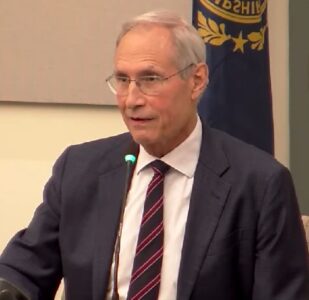
- Mayor James Donchess presents the budget for fiscal year 2027 during the June 8 budget hearing. Courtesy photo/Nashua Community Television
Greater Nashua

In defiant speech, Pezeshkian calls out Trump and says Iran will fight ‘until our last breath’
Judge hears arguments without immediately ruling in lawsuit over White House ban on 3 news outlets
Zelenskyy, at UN, urges leaders to keep choking Russia’s revenues and impede its war efforts
UNITED NATIONS (AP) — Ukrainian President Volodymyr Zelenskyy told world leaders Wednesday that Vladimir Putin is ...