
Nashua men led the way at Bunker Hill
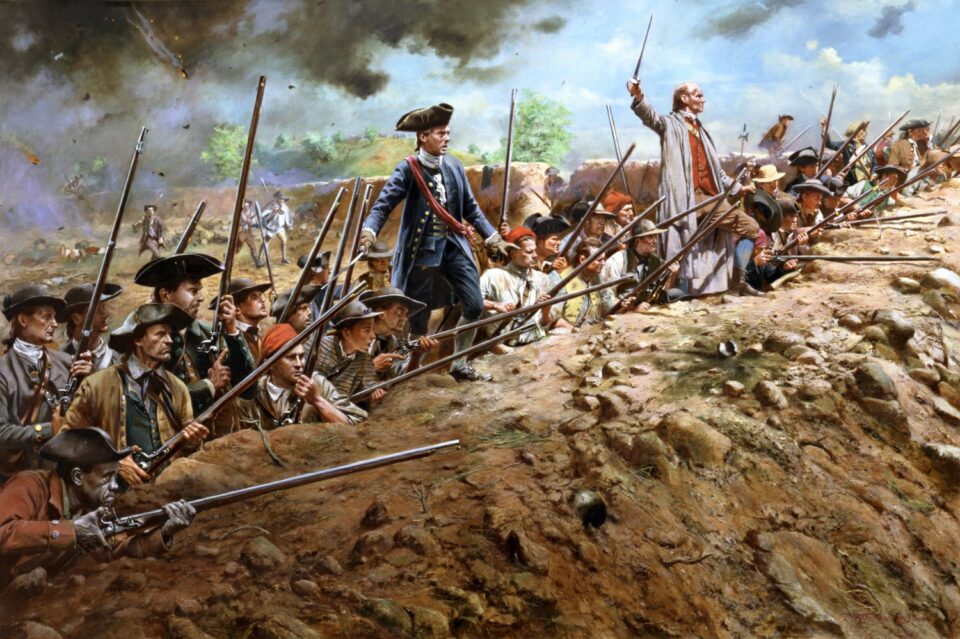
American militia at the Battle of Bunker Hill on June 17, 1775. According to historian Charles Fox, the greatest number of soldiers came from Nashua. Courtesy photo
NASHUA – Decades before Nashua was established, on the afternoon of April 19, 1775, residents of what was then Dunstable were enraged when word reached them about the American defeat at the Battle of Lexington earlier that day.
Less than a week later, 66 men made the 36-mile trek from Dunstable to Cambridge, Mass. and formed the Army’s Sixth Company led by Capt. William Walker.
“From no other town in New Hampshire was there so large a number in the Army,” said historian Charles Fox on page 173 of his book, History of the Old Township of Dunstable.
Some of the soldiers under Walker’s command included John Lund, Simeon Butterfield, Joseph Greeley and James Harwood. The Dunstable men were among the most passionate in the young nation’s quest for independence drawing on the spirit of their fathers who had served in the French Wars.
Known for their tenacious fighting ability, Walker’s men arrived at the Battle of Bunker Hill on June 17, 1775 and were “placed at the high point of the British attack,” according to the U.S. Congressional Record. That position put the company directly in the path of the British force under Maj. Gen. William Howe.
Walker’s company was also tasked with helping defend the rail fence, a crucial foothold on the American left flank.
During the battle, militia from New Hampshire and Massachusetts pushed back the first two British assaults on Breed’s Hill.
It was also reported that Lt. Col. Ebenezer Bancroft of Dunstable was the last man on the battlefield and was credited with killing British Maj. John Pitcaim, who led 300 Marines through the American lines.
However, a shortage of ammunition ultimately forced the Americans to retreat.
Although the British won the day, they lost 226 troops while the American losses totaled 138. Four men in Walker’s company made the ultimate sacrifice that day. They included Paul Clogston, Asa Cram, Jonathan Gray, Jason Russell and Oliver Wood.
Despite the American defeat, Bunker Hill proved that even a ragtag militia could wage a valiant fight against what was then the world’s supreme fighting force.
Greater Nashua
In defiant speech, Pezeshkian calls out Trump and says Iran will fight ‘until our last breath’
Judge hears arguments without immediately ruling in lawsuit over White House ban on 3 news outlets
Zelenskyy, at UN, urges leaders to keep choking Russia’s revenues and impede its war efforts
UNITED NATIONS (AP) — Ukrainian President Volodymyr Zelenskyy told world leaders Wednesday that Vladimir Putin is ...