New museum space celebrates New Orleans artist John T. Scott
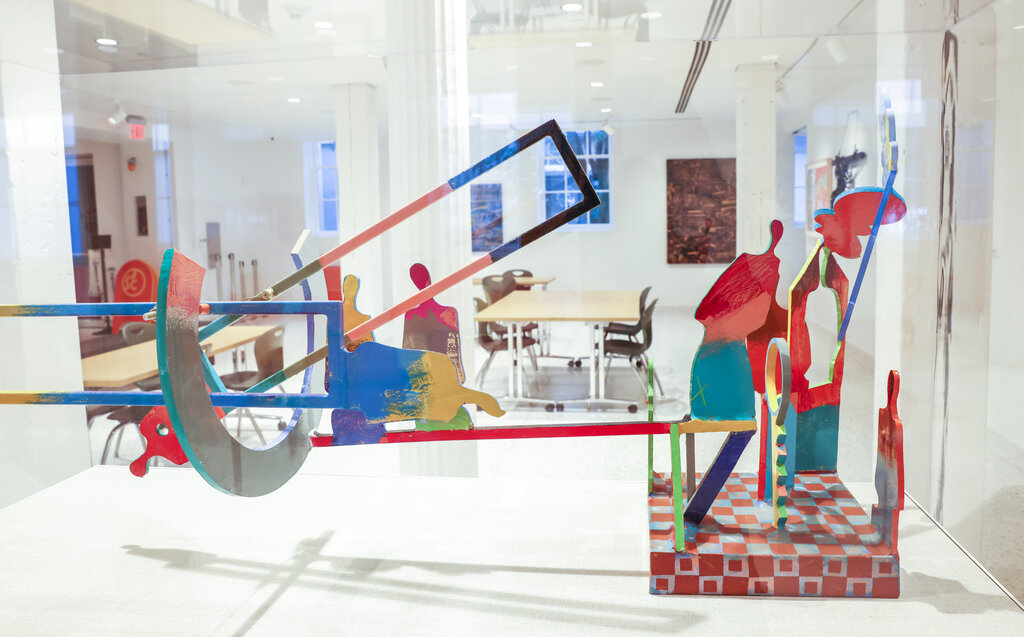
John Scott's sculpture 'Off the Edge: Neighborhood Block' sits in the middle of meeting rooms at the Helis Foundation John Scott Center in the Louisiana Endowment for the Humanities building in New Orleans, La., Friday, Aug. 26, 2022. The grand opening for the John Scott Center is Sept. 10. (Sophia Germer/The Times-Picayune/The New Orleans Advocate via AP)
NEW ORLEANS (AP) — The late John T. Scott was probably the most influential New Orleans artist of the 20th century. His monumental abstract sculptures can still be found across the cityscape, and the generations of artists he taught, in his 42 years as a Xavier University professor, are carrying his legacy forward.
Scott’s role as a star of the local art scene was already well established by 1992, when he was anointed with a “genius grant” from the John D. and Catherine T. MacArthur Foundation, expanding his reputation nationally.
Now, a new museum and meeting center in the Central Business District provide a place to commune with Scott’s art, for those already well aware of his cultural contribution and those who are discovering him for the first time.
The Helis Foundation John Scott Center is located at 938 Lafayette St. in an 1867 brick structure, known as Turners’ Hall, that was built by German immigrants as a gymnasium, dance venue and theater. It later became a sort of trade school operated by Tulane University, and later still was home to a commercial printing press that produced The Jewish Ledger newspaper.
Since 2000, Turners’ Hall has been the headquarters of the Louisiana Endowment for the Humanities, which provides grants and educational activities devoted to Bayou State arts, culture and history. The nonprofit also publishes the magazine 64 Parishes.
The Scott Center occupies the newly renovated 6,000-square-foot ground floor. The Helis Foundation, which underwrites public art projects in New Orleans, was a major contributor to the $2.6 million capital campaign that funded the new institution. Many of the 51 artworks on display are owned by the Louisiana Endowment of the Humanities, and others are on loan from the Scott Family Trust, Arthur Roger Gallery and others.
Scott was born in 1940, grew up in Gentilly and the Lower 9th Ward, attended Booker T. Washington High School, then Xavier University and Michigan State University.
He credited two Xavier instructors, Numa Roussève and Sister Mary Lurana Neely, as his most important art mentors. He also received instruction from two other stellar artists, the abstract expressionist painter Charles Pollock – brother of the legendary Jackson Pollock – and renowned kinetic sculptor George Rickey. Some of Scott’s fiery painting style and his love of wind-activated, mechanical sculpture can probably be traced to them.
But Scott’s most important influences were African. His modernist sculptures were inspired by fabric patterns, group dances and music that came to the American South with enslaved people. He particularly employed the form of the diddley bow, a single-stringed musical instrument based on a hunting weapon.
“The magic of the bow was the duality,” said artist and professor Ron Bechet, who was Scott’s colleague at Xavier University. “The way John would explain it, it was the fact that the bow was used to actually kill the prey. But then the hunter would turn it over and play a libation of music to thank the animal for giving its life so he could survive.”
Scott was also inspired by the African American experience, including jazz and the civil rights movement, plus New Orleans customs such as second-line parades.
Always experimenting, Scott produced sculptures from myriad materials, including cast bronze, welded steel and blown glass. His haunting “Urban Crucifix,” made from assembled remnants of pistols and rifles, is part of the Scott Center collection.
Outside of the collection, several of Scott’s sculptures can be found in prominent spots around town:
His swaying, sparkling, “Ocean Song” overlooks the Mississippi River in Woldenberg Park.
“Spirit House,” which was made in collaboration with artist Martin Payton, is a mint-colored abstraction perforated with human figures. It stands near the intersection of Gentilly Boulevard and DeSaix Boulevard.
The silvery “Spirit Gates” is a permanent exterior feature of the New Orleans Museum of Art, where Scott was celebrated with a retrospective exhibition in 2005.
In addition to his three-dimensional works, Scott also made wood-cut prints; some were too big for a printing press, so he drove an asphalt roller over them to transfer the ink to paper. Several of his prints, including huge portraits of Louis Armstrong, and the carved wooden blocks that Scott used to produce some of them, are on display in the Scott Center.
Scott was always a very hands-on artist. In time, however, the smoke, the sparks and the paint fumes that were an inseparable part of his artmaking began taking their toll on his health. After evacuating to Houston in the aftermath of Hurricane Katrina in 2005, Scott was hospitalized with pulmonary fibrosis.
Asked if he intended to return to New Orleans despite flood damage to both his home and studio, Scott expressed his devotion to his hometown one last time.
“That’s the only home I know,” he said. “I want my bones to be buried there. I belong there. I need New Orleans more than New Orleans needs me.”
Despite two attempted lung transplants in Houston, Scott died in 2007. His ashes were returned to New Orleans, a friend said.
The director of the new John Scott Center, Asante Salaam, is a visual artist, and a former student of Scott. She previously worked for the New Orleans mayor’s office of cultural economy, the New Orleans Jazz & Heritage Foundation, the Louisiana State Museum and other institutions.
As she led a preview tour of the new space last week, Salaam commented on her former teacher’s lingering aura.
“Everyone who knew him or knew of him lights up inside,” she said.
Some of Scott’s work is critical of the racist society he endured. His aluminum construction titled “I Remember Birmingham” is a fiery tangle of dark silhouettes inspired by the bombing of the 16th Street Baptist Church by white supremacists in that Alabama city in 1963.
“As a Black man, a native New Orleanian, from the 9th Ward, he went through phases of history and conflict,” Salaam said.
But the social criticism embodied in his work is often complex and subtle. And the appearance is always triumphant.
“I call him a dignified disrupter,” Salaam said.
Salaam said she hopes that the new John Scott Center, with its meeting room, reading room and art display, will be a welcoming hub for art and culture activities and a catalyst for social change.
“He was an example,” Salaam said, “a practitioner, a dedicated educator, dedicated to passing all that on.”
The Helis Foundation John Scott Center is open Thursdays, Fridays and Saturdays from noon to 6 p.m. Regular admission costs $7; children younger than 12 are admitted free.
A free grand opening celebration, with live music, sno-balls and art activities, is scheduled Sept. 10 from 10 a.m. to 3 p.m.